Evaluate in CI/CD
Run Future AGI evaluations in your CI/CD pipeline to assess model performance on every pull request and keep quality checks consistent before deployment.
CI/CD evaluation brings quality checks into your existing development workflow. Every time code changes, your eval suite runs automatically, scores your AI outputs against the templates you define, and tracks results by version.
This catches regressions before they ship and gives your team a versioned history of how AI quality changes over time. You can compare any two versions side by side to see exactly where things improved or dropped.
Future AGI never triggers or runs your pipeline. You call the SDK from your own CI, so the evals run wherever your code already builds.
When to use
- Gate PRs on quality: Run evals on every PR so regressions in tone, factual consistency, or custom metrics block or flag merges before they land.
- Compare versions in CI: Submit evaluations with a version tag and compare results across versions in one place.
- Automate quality reporting: Post eval results as a PR comment so reviewers see model performance without leaving GitHub.
- Repeatable checks: Use the same eval templates and inputs in CI so every run is directly comparable.
Prerequisites
- A Future AGI account with API key and secret key
- A CI system that can run Python (GitHub Actions, GitLab CI, Jenkins, or any runner with Python and network access)
- The
ai-evaluationpackage (pip install ai-evaluation>=0.1.7)
Required secrets
Set these as environment variables or in your CI’s secret store. Do not commit them.
| Secret | Description |
|---|---|
FI_API_KEY | Your Future AGI API key |
FI_SECRET_KEY | Your Future AGI secret key |
PAT_GITHUB | Personal Access Token for repository access (GitHub Actions only) |
Required variables
| Variable | Description | Default |
|---|---|---|
PROJECT_NAME | Future AGI project name | Voice Agent |
VERSION | Current version identifier | v0.1.0 |
COMPARISON_VERSIONS | Comma-separated versions to compare against | (empty) |
Set up the pipeline
Set this up once. On every pull request, GitHub Actions installs the SDK, runs your eval suite, tags the results with a version, and posts a comparison table back to the PR.
Note
This walkthrough is GitHub Actions specific: the workflow file, PAT_GITHUB, and the post_github_comment function all use GitHub’s API. The evaluate_pipeline and get_pipeline_results calls are identical on any runner, so to use GitLab CI, Jenkins, or another system, keep the eval script and swap post_github_comment (and the workflow file) for your platform’s equivalent.
Add the requirements file
Create requirements.txt with the packages the eval script needs:
pandas
requests
tabulate
ai-evaluation>=0.1.7
python-dotenv
Write the evaluation script
Create evaluate_pipeline.py. It submits your eval suite tagged to a version, polls for completion, formats the results as a markdown table, and posts them back to the PR. Customize the eval_data list with your own templates, models, and inputs.
from dotenv import load_dotenv
load_dotenv()

import os
import json
import time
import requests
import pandas as pd
from fi.evals import Evaluator

# Define your evaluation data - CUSTOMIZE THIS SECTION
eval_data = [
    {
        "eval_template": "tone",
        "model_name": "turing_large",
        "inputs": {
            "output": [
                "This product is amazing!",
                "I am very disappointed with the service."
            ]
        }
    },
    {
        "eval_template": "groundedness",
        "model_name": "turing_large",
        "inputs": {
            "input": [
                "What is the capital of France?",
                "Who wrote Hamlet?"
            ],
            "context": [
                "France is a country in Western Europe. Its capital and largest city is Paris, situated on the Seine river.",
                "Hamlet is a tragedy written by William Shakespeare around 1600 and is one of his best-known plays."
            ],
            "output": [
                "The capital of France is Paris.",
                "William Shakespeare wrote Hamlet."
            ]
        }
    }
]

def post_github_comment(content):
    """Posts a comment to a GitHub pull request."""
    repo = os.getenv("REPO_NAME")
    pr_number = os.getenv("PR_NUMBER")
    token = os.getenv("GITHUB_TOKEN")

    if not all([repo, pr_number, token]):
        print("Missing GitHub details. Skipping comment.")
        return

    url = f"https://api.github.com/repos/{repo}/issues/{pr_number}/comments"
    headers = {
        "Authorization": f"token {token}",
        "Accept": "application/vnd.github.v3+json",
    }
    data = {"body": content}

    response = requests.post(url, headers=headers, data=json.dumps(data))

    if response.status_code == 201:
        print("Successfully posted comment to PR.")
    else:
        print(f"Failed to post comment. Status code: {response.status_code}")

def poll_for_completion(evaluator, project_name, current_version,
                        comparison_versions_str="", max_wait_time=600,
                        poll_interval=30):
    """Polls for evaluation completion by fetching all versions."""
    start_time = time.time()

    comparison_versions = []
    if comparison_versions_str:
        comparison_versions = [v.strip() for v in comparison_versions_str.split(',') if v.strip()]

    all_versions = list(set([current_version] + comparison_versions))

    while time.time() - start_time < max_wait_time:
        elapsed_time = int(time.time() - start_time)
        print(f"Polling for results (elapsed: {elapsed_time}s/{max_wait_time}s)...")

        try:
            result = evaluator.get_pipeline_results(
                project_name=project_name,
                versions=all_versions
            )

            if result.get('status'):
                api_result = result.get('result', {})
                status = api_result.get('status', 'unknown')
                evaluation_runs = api_result.get('evaluation_runs', [])

                if status == 'completed':
                    print(f"All requested versions are complete.")
                    return evaluation_runs
                elif status in ['failed', 'error', 'cancelled']:
                    print(f"Evaluation failed with status: {status}")
                    return None
        except Exception as e:
            print(f"Error polling for results: {e}")

        time.sleep(poll_interval)

    print(f"Timeout after {max_wait_time} seconds")
    return None

def format_results(evaluation_runs, current_version):
    """Formats results into a markdown comparison table."""
    if not evaluation_runs:
        return "No evaluation results found."

    version_data = {run.get('version'): run.get('results_summary', {})
                    for run in evaluation_runs}

    # Collect all metrics
    all_metrics = set()
    for run in evaluation_runs:
        for key, value in run.get('results_summary', {}).items():
            if isinstance(value, dict):
                for sub_key in value.keys():
                    all_metrics.add(f"{key}_{sub_key}")
            else:
                all_metrics.add(key)

    comparison_data = []
    for metric in sorted(all_metrics):
        row = {'Metric': metric.replace('_', ' ').title()}
        for version in sorted(version_data.keys()):
            results = version_data[version]
            value = results.get(metric, 'N/A')
            if isinstance(value, float):
                formatted = f"{value:.2f}".rstrip('0').rstrip('.')
            else:
                formatted = str(value)
            label = f"{version} {'(current)' if version == current_version else ''}"
            row[label] = formatted
        comparison_data.append(row)

    df = pd.DataFrame(comparison_data)
    return f"**Current Version:** {current_version}\n\n### Metrics Comparison\n\n{df.to_markdown(index=False)}\n"

def main():
    project_name = os.getenv("PROJECT_NAME", "Voice Agent")
    version = os.getenv("VERSION", "v0.1.0")
    comparison_versions = os.getenv("COMPARISON_VERSIONS", "")

    try:
        evaluator = Evaluator(
            fi_api_key=os.getenv("FI_API_KEY"),
            fi_secret_key=os.getenv("FI_SECRET_KEY")
        )
    except Exception as e:
        post_github_comment(f"## Evaluation Failed\n\n**Reason:** Failed to initialize evaluator: {e}")
        return

    try:
        result = evaluator.evaluate_pipeline(
            project_name=project_name,
            version=version,
            eval_data=eval_data
        )
        if not result.get('status'):
            post_github_comment(f"## Evaluation Failed\n\n**Reason:** {result}")
            return
    except Exception as e:
        post_github_comment(f"## Evaluation Failed\n\n**Reason:** Error submitting evaluation: {e}")
        return

    all_runs = poll_for_completion(evaluator, project_name, version, comparison_versions)

    if not all_runs:
        post_github_comment("## Evaluation Failed\n\n**Reason:** Timed out or failed during processing")
        return

    comment_body = format_results(all_runs, version)
    post_github_comment(comment_body)

if __name__ == "__main__":
    main()
Add the GitHub Actions workflow
Create .github/workflows/evaluation.yml to run the script on every PR against main:
name: Run Evaluation on PR

on:
  pull_request:
    branches:
      - main

jobs:
  evaluate:
    runs-on: ubuntu-latest
    permissions:
      pull-requests: write
    steps:
      - name: Check out repository code
        uses: actions/checkout@v4
        with:
          token: ${{ secrets.PAT_GITHUB }}

      - name: Set up Python
        uses: actions/setup-python@v5
        with:
          python-version: '3.10'

      - name: Install dependencies
        run: pip install -r requirements.txt

      - name: Run evaluation script
        run: python evaluate_pipeline.py
        env:
          GITHUB_TOKEN: ${{ secrets.GITHUB_TOKEN }}
          PR_NUMBER: ${{ github.event.number }}
          REPO_NAME: ${{ github.repository }}
          FI_API_KEY: ${{ secrets.FI_API_KEY }}
          FI_SECRET_KEY: ${{ secrets.FI_SECRET_KEY }}
          PROJECT_NAME: ${{ vars.PROJECT_NAME || 'Voice Agent' }}
          VERSION: ${{ vars.VERSION || 'v0.1.0' }}
          COMPARISON_VERSIONS: ${{ vars.COMPARISON_VERSIONS || '' }}
Note
Critical: You must specify pull-requests: write in your workflow permissions. Without this, the action cannot post comments on your PR.
Set the required secrets and variables
In your repository settings, add the secrets and variables the workflow reads: FI_API_KEY, FI_SECRET_KEY, and PAT_GITHUB as secrets, and PROJECT_NAME, VERSION, and COMPARISON_VERSIONS as repository variables. Never commit them to the repo.
Open a pull request and read the results
Open a PR against your target branch. The workflow runs automatically and posts a comment with the current version identifier and a metrics comparison table across versions.
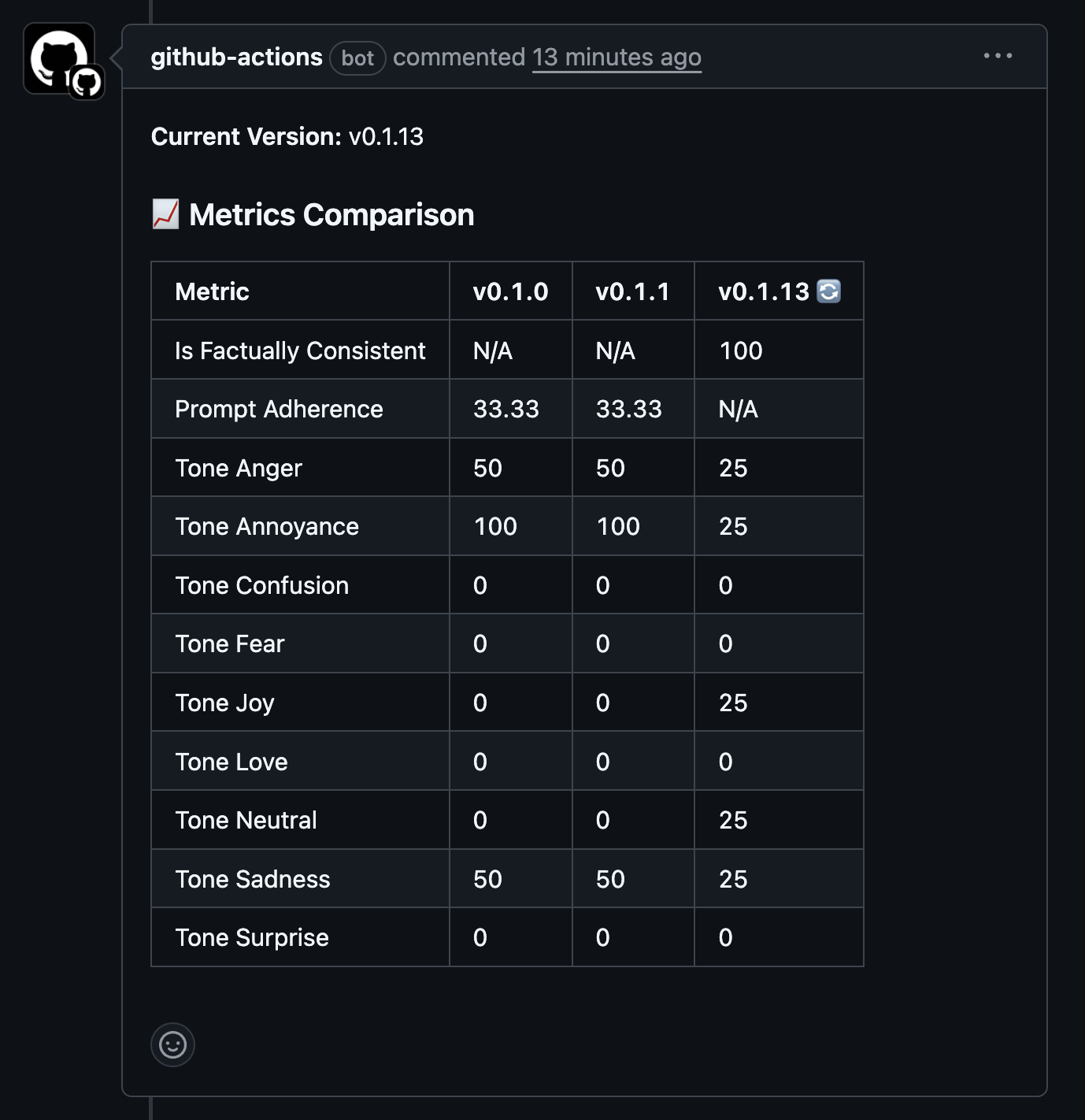
The workflow posts the current version and a per-version metrics comparison table back to the PR
How the SDK calls work
The pipeline uses two Evaluator methods: evaluate_pipeline submits an eval run tagged to a version, and get_pipeline_results retrieves and compares results across versions. Initialize the evaluator with your keys first:
from fi.evals import Evaluator

evaluator = Evaluator(
    fi_api_key=os.getenv("FI_API_KEY"),
    fi_secret_key=os.getenv("FI_SECRET_KEY"),
)
evaluate_pipeline
Submits a list of eval configs tagged to a version. Each config has an eval_template, a model_name, and inputs (keys mapped to lists of values). For more on templates and inputs, see Running Evaluations.
result = evaluator.evaluate_pipeline(
    project_name="my-project",
    version="v0.1.5",
    eval_data=eval_data,
)| Parameter | Description |
|---|---|
project_name | Your project identifier |
version | Version tag for this run (e.g. branch name or commit SHA) |
eval_data | List of evaluation configurations (template, model, inputs) |
get_pipeline_results
Retrieves results for one or more versions so you can compare them side by side.
result = evaluator.get_pipeline_results(
    project_name="my-project",
    versions=["v0.1.0", "v0.1.1", "v0.1.5"],
)| Parameter | Description |
|---|---|
project_name | Your project identifier |
versions | List of version tags to retrieve results for |
Troubleshooting
| Issue | Solution |
|---|---|
| GitHub API errors when posting comments | Ensure pull-requests: write permission is set in the workflow. Verify PAT_GITHUB has repository access. |
| Evaluation fails to submit | Check that FI_API_KEY and FI_SECRET_KEY are correctly configured in GitHub secrets. |
| Timeout waiting for results | Increase max_wait_time in poll_for_completion for complex evaluations. Check network connectivity. |
| Wrong or missing metrics | Verify eval data format matches your templates. Check template names are correct. |
Dive deeper
Questions & Discussion